

The promise of “smart” technology is straightforward: more data, more visibility, better decisions. Install the device, connect the app, and the system begins to reveal what was previously hidden. Consumption becomes measurable. Anomalies become detectable. Patterns emerge. The assumption is that with enough visibility, the system effectively improves itself. But in practice, something else happens alongside this increase in capability.
Responsibility shifts.
In my case, I’ve been invited by my local water utility to install a Flume Smart Home Water Monitor—discounted from $279 to $79. The pitch is real-time visibility into my water use and early leak detection, but the deeper logic is the utility’s: the more precisely it can see where water is going, the less it loses to leaks and billing gaps—recovering missed revenue and avoiding the cost of water that never gets paid for. Customers are no longer mere consumers outside the system; they are enrolled in it as nodes of distributed quality control.
More data does not eliminate uncertainty. It reorganizes it—and assigns it.
This is the first layer of what such systems do. They increase visibility at the event level. Things that were once submerged in the background of daily life are surfaced as discrete occurrences—alerts, spikes, deviations. The system becomes more transparent in one sense: more of what is happening is now visible.
But visibility alone does not resolve anything. It only raises a new question: what should be done with what is now seen?
This is where the more consequential shift occurs. The system does not simply show events; it invites, and increasingly requires, interpretation. Patterns must be tracked. Deviations must be judged. Alerts must be triaged. What counts as normal? What counts as waste? What requires action, and what can be ignored?
In other words, visibility becomes responsibility.
The user's role changes substantially. Instead of being a passive endpoint—receiving a bill, paying for a service—customers become active participants in managing the system. Flume users are now responsible for interpreting what the system makes visible and deciding how to respond. The system has not eliminated uncertainty; it has relocated it. It has also made that uncertainty visible—and monetized it, turning previously unmeasured conditions into priced forms of value counted in the GDP where none existed before.
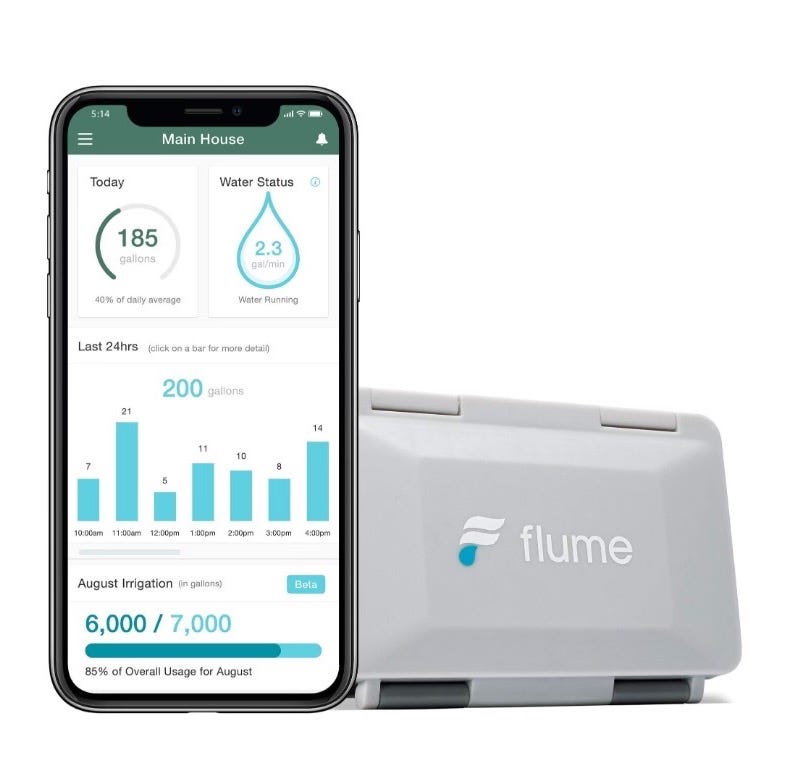
What makes this shift easy to miss is that it feels like empowerment. More information is typically understood as more control. And in a limited sense, that is true. I can now detect leaks earlier. I can adjust behavior. I can reduce waste. But these gains come with an accompanying transfer of burden, frustration, expense, and time. The system is no longer simply a service-delivery mechanism; it must now be continuously monitored and managed by customers and users.
This pattern is not unique to water usage. It reflects a broader shift toward emerging systems that replace simple, opaque arrangements—where use was estimated and loosely monitored—with continuous tracking, drawing actors into the system as participants rather than leaving them outside it.
Health tracking devices measure heart rate, sleep, and activity, producing streams of data that must be interpreted. Financial apps categorize spending and offer breathless alerts, but leave budgeting and risk decisions to the user. Energy dashboards track consumption in real time, but do not determine what trade-offs are worth making. In each case, visibility increases, but so does the expectation that the individual will rationally act on what is revealed, if at all.
What these systems produce is not structural understanding, but legibility at the level where action is possible. This new regime replaces simple, low-visibility arrangements with continuous data systems that reorganize how knowledge is produced and acted on—an epistemic transformation, not just a technical upgrade. They make systems more observable and manageable, without fundamentally altering the constraints within which they operate. The underlying economics remain. The pricing structures remain. The limits remain. What changes is who is expected to manage those constraints.
This is where the distinction matters. Increased visibility at the event level becomes actionable at the pattern and adjustment levels—the levels at which users track, respond, and optimize. But the system's deeper structure remains intact. The system has not become simpler; it has become more visible at the surface.
As a result, responsibility follows visibility. The more a system reveals, the more it expects the watchers to respond.
This helps explain a broader feature of contemporary technological systems. As procedural and technological capacities increase, they tend to surface more information without resolving the question of what to do with it. The system becomes more capable, but the burden of interpretation shifts outward. What appears as empowerment is also a redistribution of responsibility, and sometimes a waste of time.
Seen in this light, “smart” systems do not simply make life easier. They reorganize where decisions are made. Tasks that were once handled by institutions, utilities, or background processes are increasingly pushed down to the individual level. The system does not disappear; it becomes something that must be continuously engaged.
The result is a subtle but significant shift. We are not just users of systems; we are managers of their outputs. And this management takes place in a space where visibility is high, but direction remains underdetermined.
More data does not eliminate the need for judgment. It expands it. And that expansion is not neutral. It redistributes responsibility in ways that are often less visible than the technologies that produce it. And they have a cost beyond the checkbook.
What accompanies this shift is a new kind of burden. The same systems that promise clarity and control also introduce a steady demand for attention—alerts to check, patterns to interpret, small decisions to make. The result is a diffuse, prerequisite, ongoing cognitive load added to everyday life: a low-grade vigilance that registers more as friction and hassle than as empowerment. Multiply by the number of systems in our lives, and we begin to see a new conga line of modern stressors.
This is not a failure of the technology. It is a feature. As visibility increases, responsibility follows. What changes is not the system's structure, but the location of the work required to navigate it. Tasks that were once absorbed by institutions are redistributed to individuals, who must now interpret and respond in real time.
Here’s what you’ll get for $79: a world in which more is visible, and more is actionable, but less is settled. What a deal. Systems become easier to observe and harder to ignore. They demand engagement without supplying clear direction, shifting the burden of judgment onto those least able to resolve the constraints they face.
More data does not eliminate uncertainty. It reorganizes it—and assigns it.
Now get to work.